What should an AI book editor change, and what should it leave alone?
An AI book editor should change the passage you point it at and leave the rest of the manuscript exactly as you wrote it.
You already have the manuscript. What you need is help understanding it and revising specific parts of it — not a tool that hands back a different book and leaves you to work out what changed.
Why one giant “edit my book” prompt fails
Feeding an entire manuscript into a single request produces something fluent, plausible, and impossible to check. Somewhere in ninety thousand words, a character’s motivation shifted, a qualification you needed for legal reasons vanished, and a callback in chapter twelve no longer has anything to call back to.
You cannot review a change that size. So you either accept it on faith — which is how books lose their author — or you throw it away and do the work yourself, having spent the afternoon anyway.
Understand the book before changing its prose
Most editing mistakes at book length are orientation mistakes: you change a paragraph without remembering what chapter four already established. So before you touch the prose, read around it — ask where a term was introduced, how a thread develops, or what this chapter is currently doing for the ones on either side of it.
Those answers come from your current approved drafts, so they describe the manuscript as it stands rather than a version you have since rewritten. They can still be incomplete, and they are not a finding: what you know about your own book outranks them, and anything that matters is worth confirming in the chapter itself.
Revise one unit — or one passage — at a time
- Open the writing unitA chapter or section is its own draft, so you are never editing inside a ninety-thousand-word document.
- Narrow the scope further if you canSelect the specific passage that has the problem. A smaller scope produces a change you can actually judge.
- Describe the problem“This paragraph repeats the point from chapter two” is a workable instruction. “Improve this” is not.
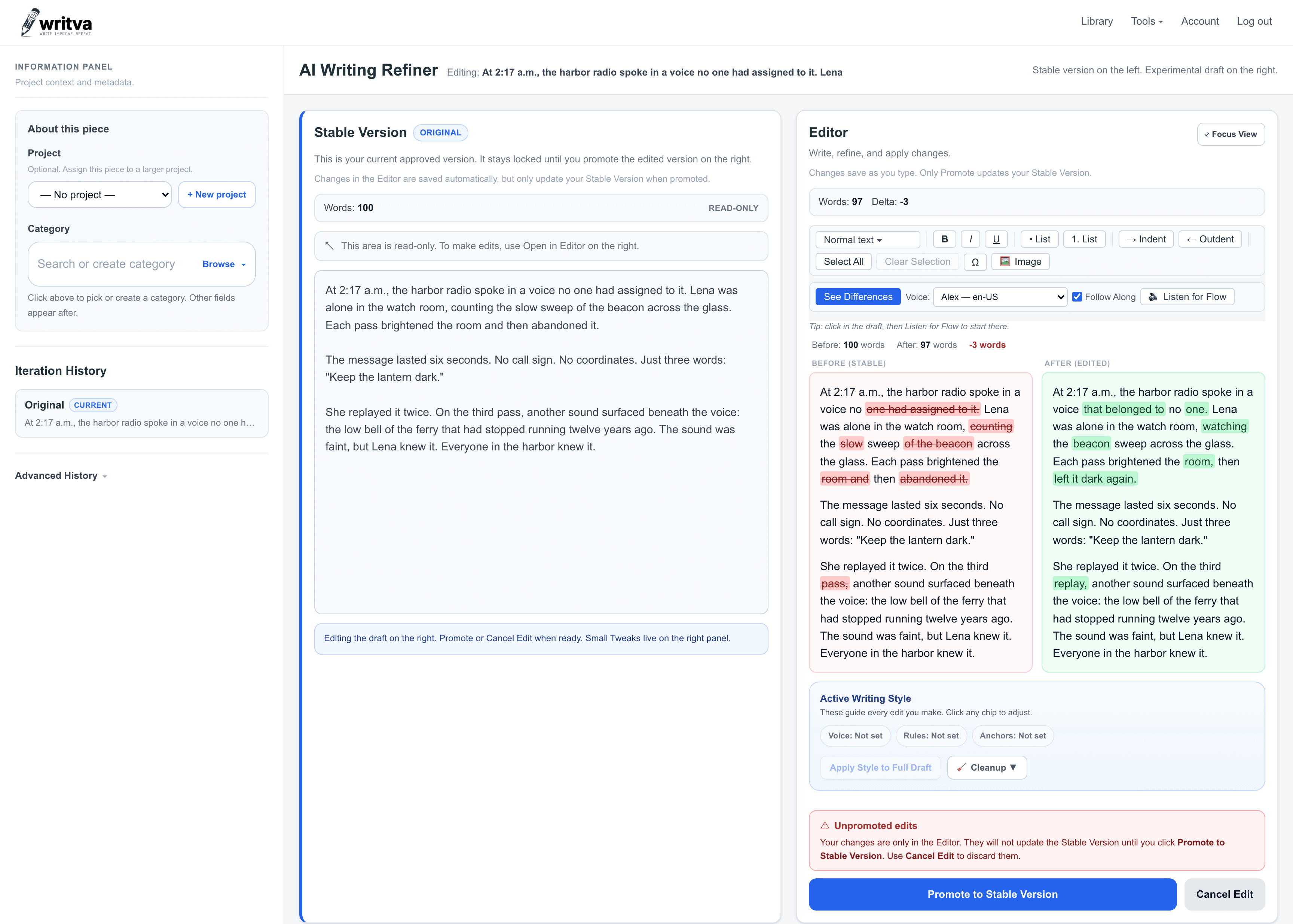
- Compare against the approved draftThe proposal appears in the Edited Version beside your Stable Version.
- Accept deliberatelyPromote when it is genuinely better; the previous version stays in your history either way.
Every promotion keeps the previous version where you can preview and restore it. Over a long revision that is the difference between trying something and risking something.
A worked example
From a hypothetical nonfiction manuscript about urban planning.
The concern
Reading chapter seven in sequence, the author notices its opening re-explains what a “desire path” is — a term already defined carefully in chapter two. The repetition makes the later chapter feel like it does not trust the reader.
The bounded instruction
“This opening paragraph redefines a term the reader already met in chapter two. Cut the definition and start from the example instead, keeping the same length.”
A possible revision
The paragraph now opens on the worn diagonal track across the campus lawn and moves straight into what the university did about it — the definition gone, the example carrying the weight.
What the author checked
That the example still makes sense without the definition immediately before it. That the chapter still connects to the paragraph that follows. That no claim about the university was introduced that the source material does not support. Only the author can check the third one.
Why no full rewrite was needed
One paragraph had one problem. Regenerating the chapter would have produced dozens of changes the author never asked for, in exchange for a fix that took one instruction.
Illustrative, not a guaranteed output.
What AI helps with, and what it cannot judge
Genuinely useful for
- Finding where you covered something across a long manuscript
- Tightening a paragraph you have already diagnosed
- Surfacing possible repetition worth checking
- Second opinions on clarity in a specific passage
- Keeping earlier drafts recoverable while you experiment
Cannot determine reliably
- Whether a fact, quotation or statistic is true
- Whether your argument actually persuades
- Whether a scene earns its emotional beat
- Every continuity error across a whole book
- When the manuscript is finished
Questions about editing a book with AI
Will it rewrite my whole manuscript?
Not unless you ask it to, section by section. Writva is built around revising one writing unit — or one selected passage inside it — at a time, so you can actually evaluate what changed.
Can it answer questions about my book?
It can work from your Binder structure and your current approved drafts to help you find where something was explained or how a thread runs. Treat it as a reading aid: useful for orientation, not an authority on your manuscript.
Will it catch continuity errors?
It can help you review a manuscript and surface things worth checking, but it does not guarantee it will find every continuity problem. A clean review is not proof that nothing is wrong.
Does it replace a human editor?
No. It has no view on whether your book works, whether the argument lands, or whether the ending earns itself. Those are the questions a developmental editor answers.
How does this differ from Book Builder?
Book Builder is where the project is organized — the structure, the source material, and which draft of each unit is the approved one. This page is about what happens inside a unit that already has words in it: revising a chapter or a passage, and reviewing the change before it becomes the manuscript. Most writers use both, at different moments.
Edit the manuscript you already have
Start with the one chapter you know needs work.
Related
- How to Edit a BookEditing a whole manuscript in passes, from structure to sentences.
- Book BuilderOrganize a book-length project and keep its structure workable.
- Manuscript Revision SoftwareThe whole revision system, from structure to review copy.
- For AuthorsLong-form drafting, revision, versions, and manuscript review.
- How to Edit Selected Text With AIThe method: scope, instruction, review, accept.